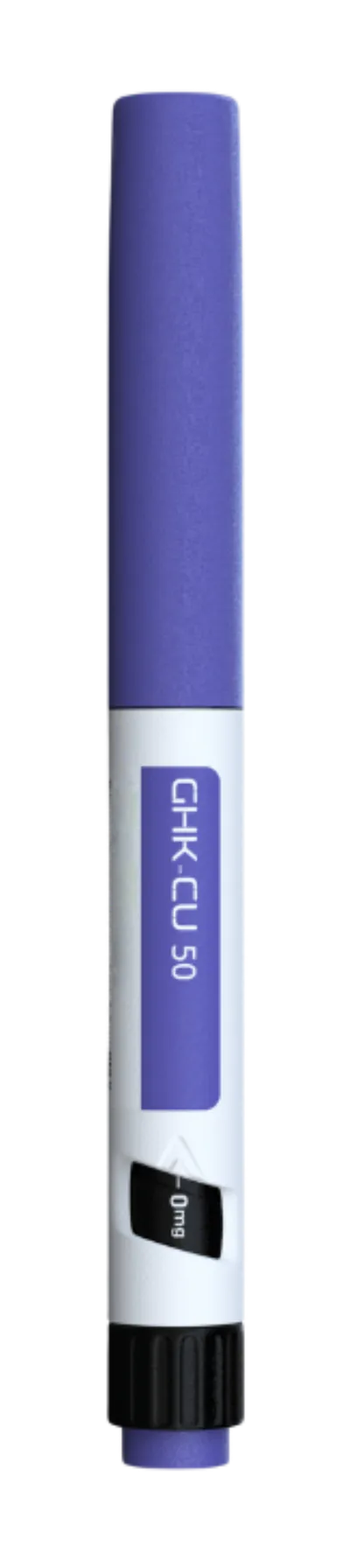
GHK-Cu (Copper Tripeptide-1) is a copper-conjugated research peptide composed of glycyl-L-histidyl-L-lysine bound to a copper(II) ion. The presence of the copper conjugate is what distinguishes GHK-Cu from the parent GHK tripeptide, and verification must confirm both peptide purity and successful copper conjugation. The Certificate of Analysis on this page documents HPLC purity of the GHK peptide backbone in the finished pen formulation, with copper conjugation confirmed by visible chromophore.
In-House Testing
BodyPharm laboratory
- Report
- #20251127
- Batch
- GHK1162
- Purity (HPLC)
- 99.90%
- Concentration
- 17.6 mg/ml
Testing Methodology
HPLC Purity of the GHK Backbone
BodyPharm in-house report #20251127 documents Reverse-Phase HPLC analysis of batch GHK1162 at 99.90% purity, the highest purity reading in the BodyPharm catalogue. The GHK tripeptide is short, polar, and readily resolved as a single peak on a standard C18 column. The high purity is supported by GHK relatively simple synthesis compared to longer peptides, with fewer opportunities for amino acid coupling errors during solid-phase synthesis. Per-batch HPLC testing is repeated for every production run with a unique report number for traceability.
Copper Conjugation Verification
The blue colour of GHK-Cu solution is the most immediate visual indicator of successful copper conjugation. Free GHK peptide is colourless; the chromophore at approximately 570 nm wavelength is produced by the d-d electronic transitions of the bound copper(II) ion. The pen formulation visibly displays this blue colour through the cartridge window. Quantitative copper analysis is performed on representative batches; the 17.6 mg/ml concentration on the COA reflects the GHK-Cu complex (peptide plus copper) rather than peptide alone.
Oxidation and Storage Stability
GHK-Cu is sensitive to oxidation when exposed to atmospheric oxygen, with the copper ion catalysing the formation of degradation products if the pen is left at room temperature for extended periods. Storage at 2-8C in the original sealed pen preserves the chromophore and prevents oxidative decomposition. The HPLC test is performed shortly after fill and reflects starting material; researchers using GHK-Cu in extended studies should reconfirm material integrity by visual inspection of the blue colour at each use.
What This Result Means for Researchers
GHK-Cu research applications span dermal biology and skin matrix remodelling, with documented effects on collagen synthesis, gene expression in dermal fibroblast models, and copper-dependent enzyme activity. The copper ion is integral to the molecule biological activity in research models - free GHK peptide and free copper salts produce different effects than the conjugated complex. Studies indicate the GHK-Cu complex modulates expression of genes involved in extracellular matrix remodelling, including collagen, decorin, and certain matrix metalloproteinases. The pre-filled pen format provides a stable, refrigerated, sterile-filled formulation that preserves the copper conjugation and the chromophore through the documented shelf life.
Frequently Asked Questions
Related Products
GHK-Cu 50 Pen
GHK-Cu 50mg pre-filled research pen with HPLC-verified purity at 99.90% and copper-conjugated complex.